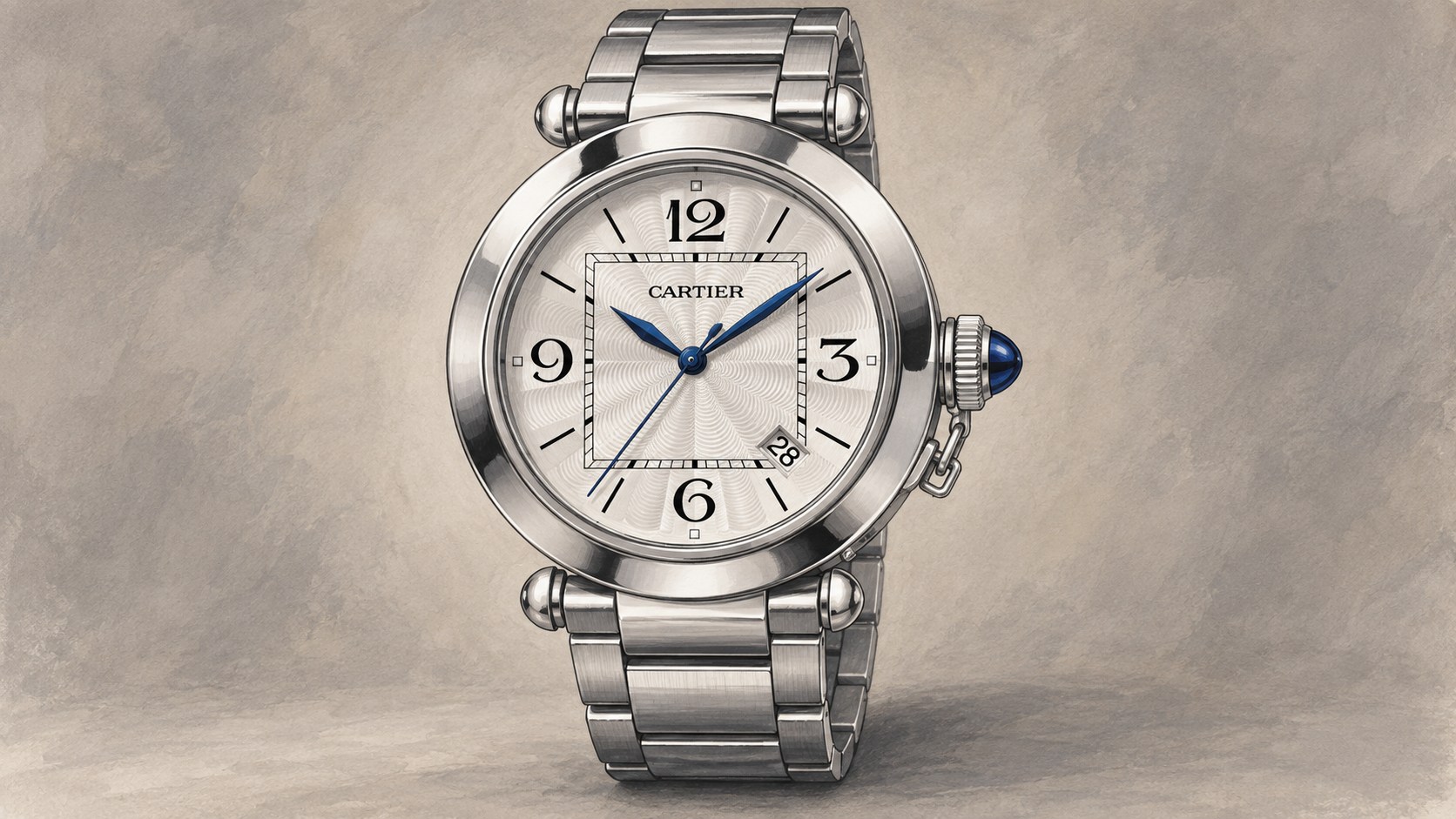
The Pasha and Santos Medium offer two very different ways to make a steel Cartier part of everyday life. The Pasha places a square within a round dial and adds a chained crown cap. The Santos lets a square case and exposed screws establish the whole watch.
Both exact references include a bracelet and a leather alternative, with modern interchangeability. That shared convenience makes the visual choice more important. You can change how either is framed on the wrist, but you cannot turn one shape into the other.
The references compared
| Feature | Pasha WSPA0009 | Santos WSSA0029 |
|---|---|---|
| Case | Round steel; 41 mm diameter | Steel; 41.9 × 35.1 mm |
| Thickness | 9.55 mm | Approximately 8.8 mm |
| Movement | 1847 MC automatic | 1847 MC automatic |
| Dial | Silver flinqué; Arabic numerals | Silvered opaline; Roman numerals |
| Calendar | Date | No date |
| Water resistance | 100 m | 100 m |
| Included attachments | Steel and grey alligator | Steel and calfskin |
| Systems | QuickSwitch; SmartLink | QuickSwitch; SmartLink |
Specifications: Pasha 41 exact specifications; Santos Medium specifications.
Pasha and Santos arrived at their shapes differently
Cartier dates the Pasha collection to 1985, with an earlier round watch of 1943 providing design inspiration. Its layered history helps explain the circle, inner square and crown cap without relying on a story about a particular royal commission.
The Santos begins with Louis Cartier’s 1904 watch for Alberto Santos-Dumont, who wanted to read time while flying. The square form and visible screws remained recognisable as the design evolved. The modern watches therefore arrive at useful everyday systems from different historical directions. Pasha preserves an emphatic 1980s identity informed by earlier Cartier work; Santos develops a much older functional shape through contemporary bracelet and strap controls.
The numbers need different interpretations
The Pasha measures 41 mm in diameter and 9.55 mm thick. The Santos Medium is 41.9 mm long by 35.1 mm wide, at approximately 8.8 mm thick. Comparing 41 with 35.1 alone would confuse a circle’s diameter with the width of a shaped case.
The Santos is the more compact-looking starting point if you want less width. The Pasha gives its dial more obvious circular presence. Neither is especially tall by the standards of many automatic sports watches, so the outline rather than thickness is likely to create the stronger first impression.
Try them from the side and from an ordinary viewing distance. A square can occupy its corners assertively despite a modest width, while a round dial may look broader because the eye reads it as a continuous surface. The bracelet also extends each design beyond the bare case.
Two unmistakable dial languages
The Pasha uses Arabic numerals and a silver flinqué treatment, with the inner square providing a second geometry. Its diamond-shaped blued hands reinforce the decorative character. The crown cap and short chain contribute something unusual outside the dial as well.
The Santos uses Roman numerals and blued sword hands against a silvered opaline face. Its bezel screws and bracelet links supply the more overtly constructed appearance. If those screws are what you enjoy, switching to leather will change the surrounding texture without removing the watch’s identity.
Choose the Pasha if its mixture of curves and geometry is the attraction. Choose the Santos if you want the case shape itself to be the central statement. A long list of shared features cannot settle that preference.
Interchangeability is a real shared benefit
Both references use QuickSwitch for changing between the supplied attachments, while SmartLink supports bracelet sizing. The Pasha comes with dark-grey alligator in addition to steel; the Santos supplies calfskin and its own interchangeable folding buckle arrangement.
This matters when you expect to use more than one configuration. Steel can make the watch feel continuous around the wrist, while leather allows the case to stand apart. If only one option appeals, judge the purchase chiefly in that form instead of assigning abstract value to the spare strap.
During a fitting, operate the systems and assess the bracelet at the length you prefer. The complete watch needs to sit properly; a convenient release mechanism does not compensate for a fit you dislike.
The movement does not decide this comparison
Both use Cartier’s automatic 1847 MC. That shared calibre name makes it particularly difficult to argue that one is a straightforward mechanical upgrade over the other. The Pasha includes a date, while this Santos Medium preserves a calendar-free dial.
The 100 m ratings are also shared. The practical differences therefore centre on what you read, how much case you want to see and which controls you enjoy handling. A buyer using the date every working day has a reason to prefer the Pasha beyond its appearance.
Which one should you choose?
Choose the Santos Medium if the compact square case and screw-defined bracelet are the design you want to wear repeatedly. Choose the Pasha if you welcome a broader round watch whose unusual details are deliberately visible.
Both can make sense as an everyday Cartier. The better choice is the one whose shape you prefer before considering the name, with the shared strap systems extending that preference into different parts of your wardrobe.
Based on manufacturer information. Specifications checked on 8 September 2026.
Image: AI-generated editorial illustration of the Cartier WSPA0009. Fine dial details and finishing may differ from the production watch.


