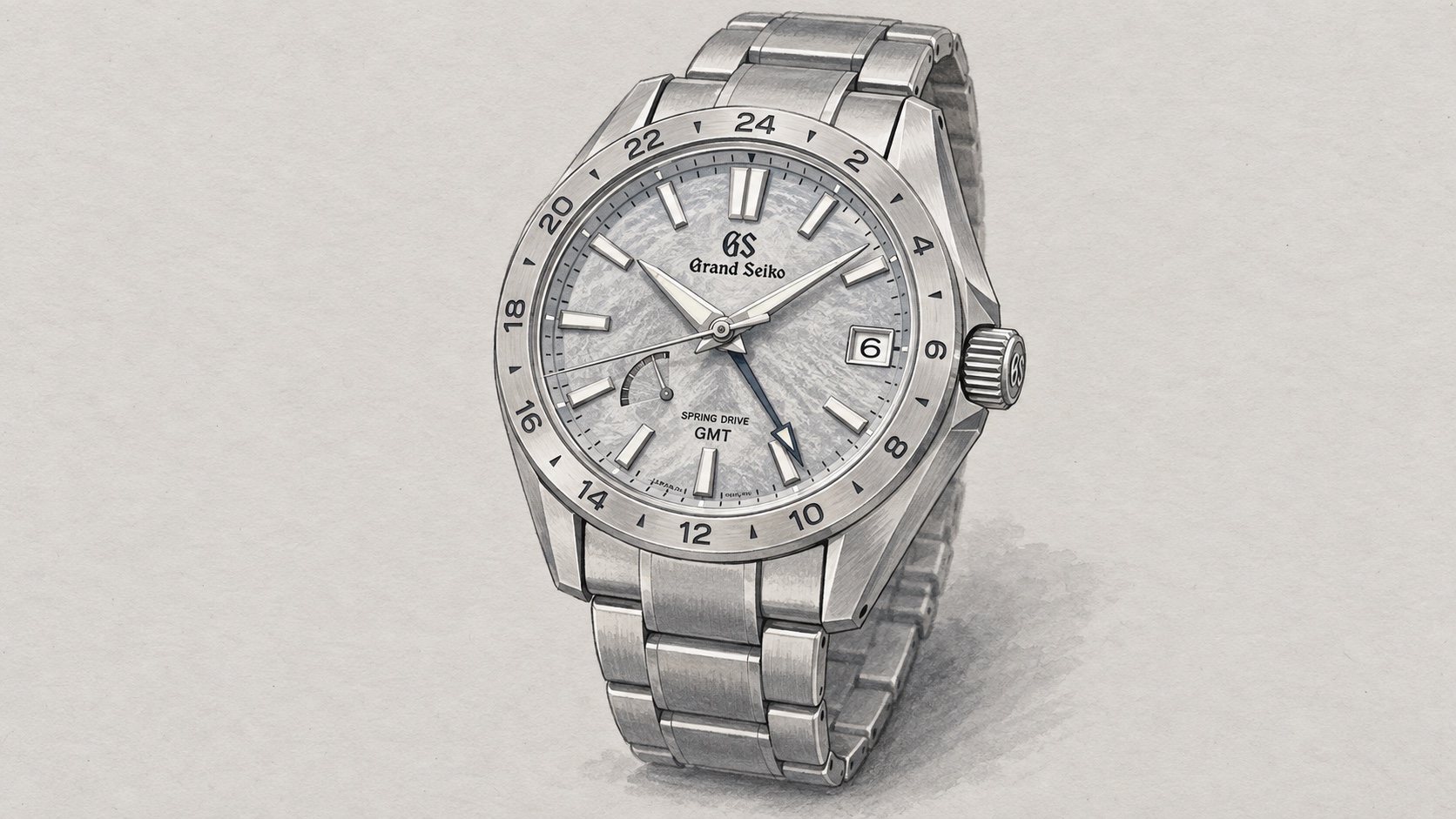
Spending more on a Grand Seiko does not necessarily buy tighter timekeeping. The SBGP011 quartz is rated to ±10 seconds per year, while the more expensive SBGE285 Spring Drive GMT is rated to ±15 seconds per month. That surprising comparison is the best place to begin.
The SBGE285 buys a different mechanism, a second-zone display and a titanium sports-watch design. The SBGP011 concentrates on accurate, uncomplicated everyday time. Choose the former because those additions interest you, rather than expecting the price ladder to be an accuracy ladder.
The references compared
| Feature | SBGE285 | SBGP011 |
|---|---|---|
| Movement | 9R66 Spring Drive | 9F85 quartz |
| Case | 41 mm titanium | 40 mm steel |
| Thickness / length | 13.9 / 48.3 mm | 10.6 / 47 mm |
| Weight | 122 g | 148 g |
| Rated accuracy | ±15 seconds per month | ±10 seconds per year |
| Energy | 72-hour reserve | Approx. 3-year battery |
| Second-zone display | 24-hour GMT hand | None |
| Local hour adjustment | Independent, calendar linked | Independent, calendar linked |
| Water resistance | 10 bar | 10 bar |
| UK listed price, 8 Sept 2026 | £7,900 | £2,450; boutique sold out |
Specifications: Grand Seiko UK SBGE285; Grand Seiko UK boutique SBGP011.
Spring Drive GMT and 9F quartz took different paths
The 9R66 Spring Drive GMT arrived in 2006, following Grand Seiko’s automatic Spring Drive development. The SBGE285 combines that established travel mechanism with the later Evolution 9 design approach. Its textured grey dial links the modern sports watch to the maker’s depiction of winter morning mist in Shinshu.
The 9F quartz family began in 1993, and the 9F85 introduced in 2020 added independently adjustable local hours to a simple three-hand display. This is not merely the absence of mechanical complexity. It is a separate development path, focused on precise timekeeping and useful controls. The two watches represent different priorities within the same manufacturer, rather than a basic model and its straightforward replacement.
The larger watch is lighter
The titanium SBGE285 weighs 122 g, against the steel SBGP011’s 148 g. Yet the Spring Drive is larger in diameter, thicker and longer. That combination makes a useful distinction between physical bulk and mass: the GMT occupies more space while weighing less on the published figures.
The 3.3 mm thickness difference is particularly relevant beneath a cuff. Choose the quartz if you want a flatter, less assertive watch. Try the GMT if you want a larger sports-watch outline without the weight you might associate with a similar steel case.
The SBGE285 also presents more information around the dial. Its GMT hand and 24-hour scale create a busier face. The SBGP011 leaves the hands, markers and date to supply the entire display, which can be a stronger everyday choice if a second time zone rarely matters.
Two forms of travel convenience
Both movements allow the local hour hand to be adjusted independently. On the 9F85, that means changing a whole-hour time zone without interrupting the established seconds setting. It is useful even though the dial has no separate home-time hand.
The 9R66 adds that second reference. You can keep one time zone visible while adjusting local time for a trip. That is worth paying attention to if you frequently call home from elsewhere or coordinate across countries. If you travel occasionally and only need local time, the quartz already supplies a valuable part of the convenience.
What Spring Drive gives you
A mainspring provides energy to Spring Drive, while an electronic regulating system controls its release. The movement generates the electricity it requires internally. It therefore offers a different technical experience from either an ordinary mechanical escapement or a conventional battery quartz watch.
The continuously moving seconds hand makes that distinction visible. For an owner fascinated by how watches work, it can be the strongest reason to choose the SBGE285. Its 72-hour reserve still means regular energy input is required. A watch left aside for a week will need attention.
The SBGP011 instead offers a nominal three-year battery life. It is a particularly coherent choice for someone who wants high-quality timekeeping without maintaining a wearing rotation around the movement.
Which difference justifies the money?
The checked UK list prices were £7,900 and £2,450 on 8 September 2026, with the SBGP011 boutique listing sold out. The gap should be justified through the GMT’s material, design and mechanism, not a claim that it tells time more accurately.
Choose the SBGE285 when a visible second zone, lighter titanium construction and Spring Drive motion are exactly what you want. Choose the SBGP011 when a thinner case, annual accuracy and readiness are the priorities. Neither needs to be treated as a compromise for wanting the other.
Based on manufacturer information. Specifications checked on 8 September 2026.
Image: AI-generated editorial illustration of the Grand Seiko SBGE285. Design details are approximate; this is not a product photograph.


