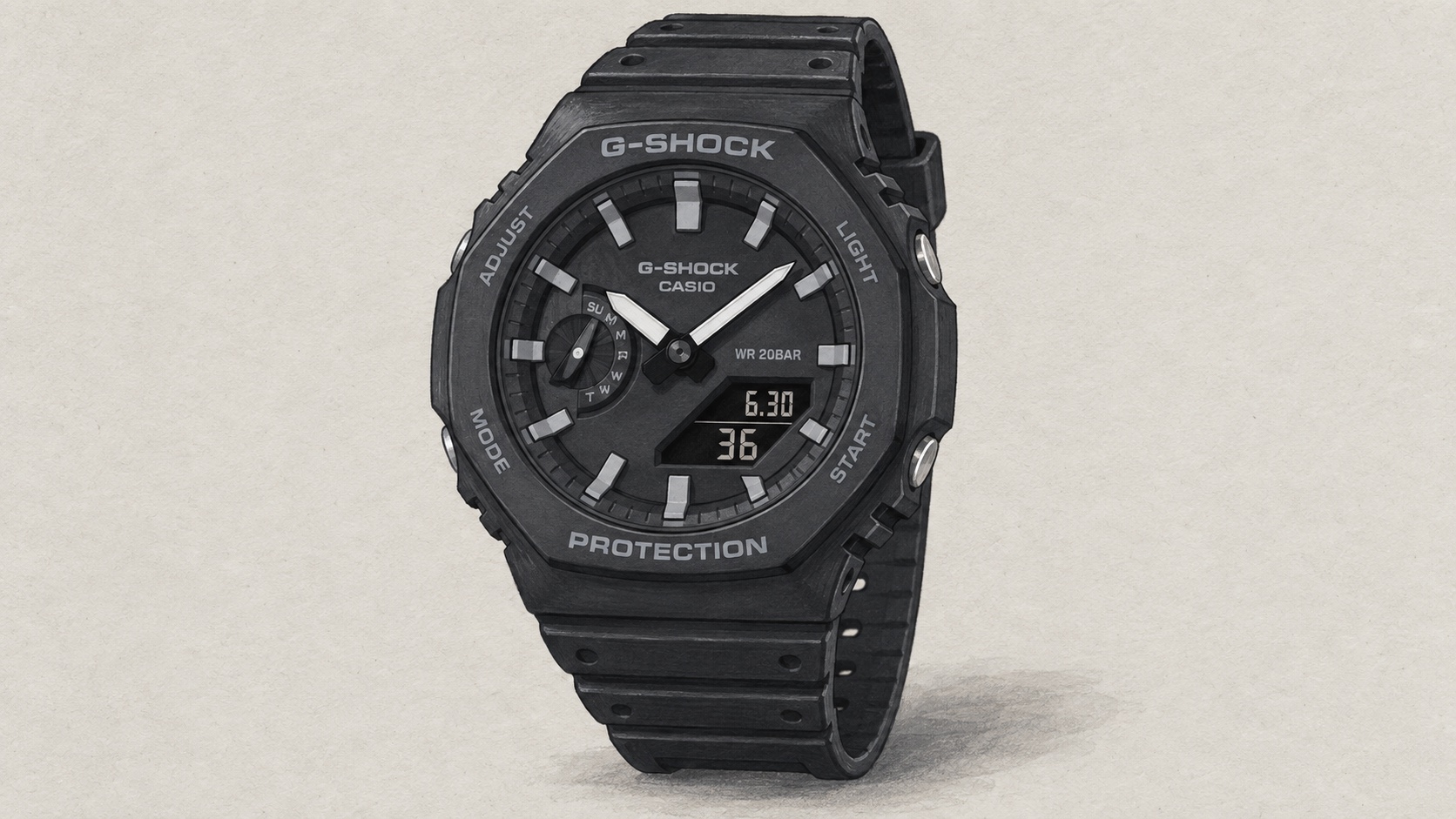
The GA-2100 is the more appealing G-Shock if you want analogue hands inside an angular, relatively thin case. The GW-M5610U is the stronger starting point if solar charging and radio-assisted time setting are the features that attract you. Their similar weights and water-resistance ratings do little to settle that choice.
Be precise about the letters in the reference. The ordinary GA-2100 compared here is battery powered and has neither Bluetooth nor Tough Solar. Solar-connected GA-B2100 variants are different watches. The comparison becomes clearer once the attractive octagonal shape is separated from features which belong to other members of its family.
The references compared
| Feature | GA-2100-1AER | GW-M5610U-1ER |
|---|---|---|
| Display | Analogue-digital | Digital |
| Dimensions | 48.5 × 45.4 × 11.8mm | 46.7 × 43.2 × 12.7mm |
| Weight | 51g | 52g |
| Power | Two SR726W cells | Tough Solar |
| Radio timekeeping | No | Multi Band 6 |
| Bluetooth | No | No |
| Crystal | Mineral | Mineral |
| Water resistance | 200m | 200m |
| Shape | Octagonal bezel | Square-derived bezel |
Two histories behind the decision
The original G-Shock of 1983 established an angular digital-watch identity which remains visible in the square family. The GW-M5610U develops that outline with later charging and radio-setting technology. Casio introduced the GA-2100 in 2019, translating a restrained angular approach into an analogue-digital watch using carbon-reinforced resin for its protective structure. The later GA-B2100 then added a different technology package. These are successive interpretations of the G-Shock idea, not interchangeable model numbers. The square keeps a more direct visual relationship with the original digital format; the octagon allows someone who prefers hands to enjoy a similarly recognisable outline without selecting one of the brand’s more elaborate large round cases.
Read the time in the format you prefer
The square devotes its main display to digital information. The GA-2100 divides the face between hands, an additional small indicator and a compact digital area. That arrangement can be attractive if you naturally read analogue time, but its secondary information occupies less space.
Compare the selected black GA-2100 configuration rather than assuming every colourway has identical contrast. The experience of finding a timer value is different from finding the hour with hands. If the digital functions are the main reason for buying a G-Shock, the square’s display format has an obvious attraction. If an analogue face makes the watch more enjoyable to wear, the octagonal model supplies that preference.
Solar charging removes one routine, not all attention
The GW-M5610U uses light to maintain a rechargeable cell. That makes adequate exposure important, especially if the watch spends long periods stored away. Its Multi Band 6 system can receive a compatible time signal when location and conditions allow; it does not guarantee successful reception everywhere.
The GA-2100 uses replaceable cells, with Casio listing an approximate three-year life under its stated conditions. That can still be a straightforward ownership proposition. Choose the square’s charging and reception functions because you value them, rather than describing the battery model as difficult to own. The practical distinction is how each watch obtains energy and corrects its displayed time.
Thinness and size point in different directions
The GA-2100 is thinner, but it is also longer and wider in Casio’s dimensions. The square weighs only a gram more. Someone choosing the octagon solely because it is described as slim could therefore overlook the dimensions that matter more on their wrist.
A fitting should compare how the resin straps leave the two cases and where the buckles sit. Their shapes are sufficiently different that a single width measurement is a poor substitute for seeing both complete watches. Neither needs to be declared a small G-Shock in every direction to have a useful place in the range.
The more useful final distinction
Both models provide timing and alarm functions within shock-resistant constructions, and both carry the same stated water-resistance rating. Their shared capabilities establish the broad G-Shock brief; they do not eliminate the differences in display and power.
Choose the GA-2100 when the octagonal frame, analogue hands and thinner profile are the qualities you want most. Choose the GW-M5610U when the digital display, solar charging and radio-setting option are the reason for the purchase. If you want the octagonal design together with solar power, compare the GA-B2100 separately using its own specifications. That is a more productive next step than attributing its features to the ordinary GA-2100 and buying the wrong reference.
Specifications and sources checked on 8 September 2026. GA-2100 specifications; GA-2100 design and later development; GW-M5610U specifications; Solar charging guidance; Radio reception guidance.
Image: AI-generated editorial illustration of the Casio GA-2100-1AER. Design details are approximate; this is not a product photograph.


