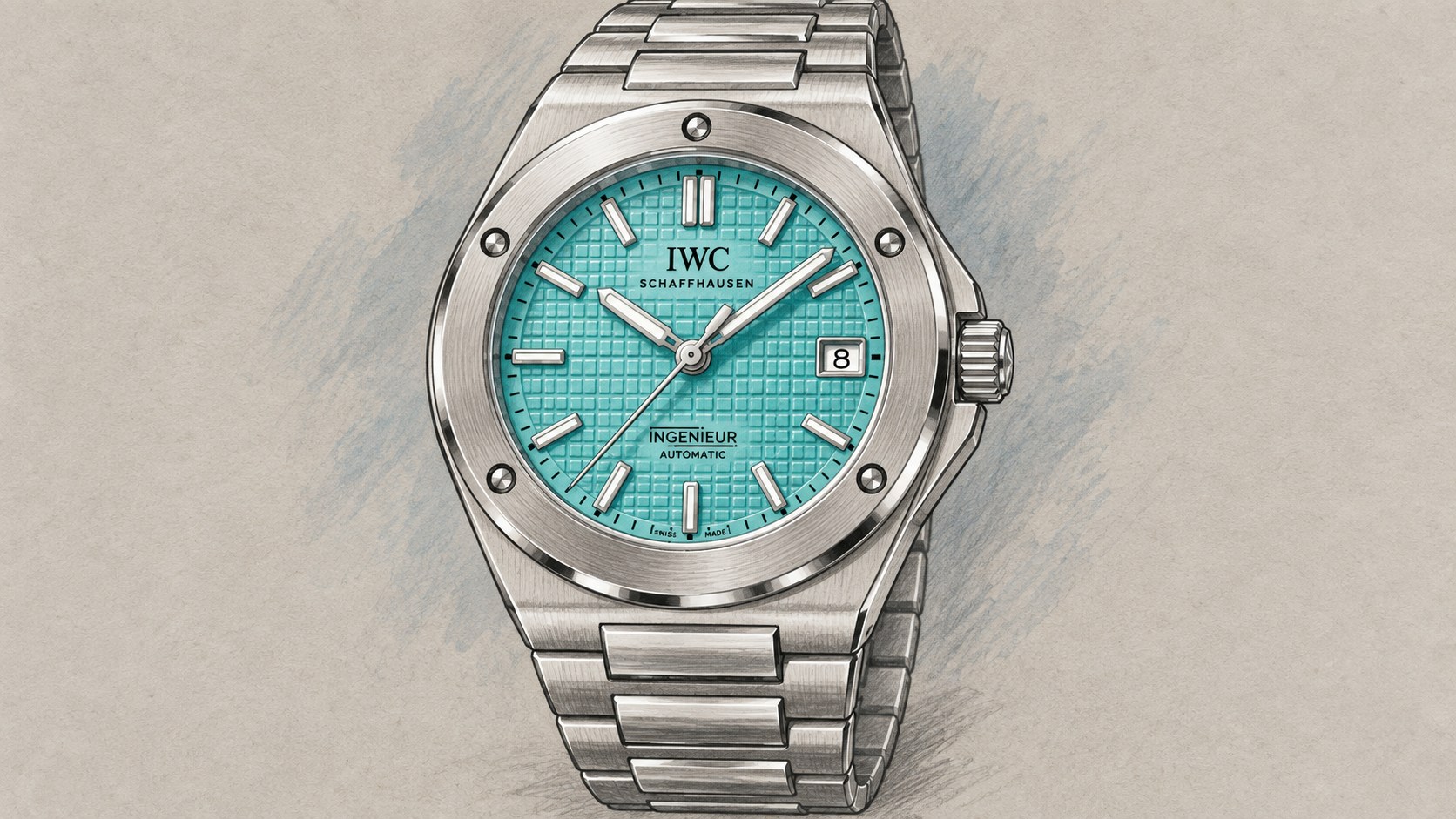
The aqua Ingenieur makes its argument through the relationship between several surfaces. The grid-pattern dial, screwed bezel and H-link bracelet belong to one composition, so the watch remains recognisable without a complication doing the work. It is worth considering if you want an integrated steel design with a strong geometric identity.
Reference IW328903 also uses IWC’s five-day automatic calibre, but that is not the whole purchase. The same named movement appears in a much quieter pilot watch. Here, the point is the enclosure around it: a textured, deliberately constructed object whose bracelet is as important as the face.
The history behind the choice
The Ingenieur first appeared in 1955 with magnetic protection as a central part of its technical purpose. Gérald Genta later transformed its visual identity through the Ingenieur SL, reference 1832, introduced in 1976. The integrated bracelet, prominent bezel and patterned dial established a very different silhouette from the earlier watch. Today’s Automatic 40 revisits that design language while using a modern movement and revised case-and-bracelet construction. The history therefore contains two related strands: practical protection for the mechanism and a distinctive approach to a luxury steel sports watch. A buyer can reasonably be drawn more strongly to one than the other, but understanding both makes the current watch more interesting than treating it as another late arrival to an integrated-bracelet fashion.
The exact reference
| Specification | Published detail |
|---|---|
| Reference | IW328903 |
| Case | Stainless steel; 40mm diameter; 10.7mm thick |
| Dial | Aqua; Grid texture; date |
| Movement | Automatic IWC-manufactured calibre 32111 |
| Reserve / frequency | 120 hours / 4Hz |
| Protection | Soft-iron inner case against magnetic fields |
| Water resistance | 10 bar; screw-in crown |
| Bezel | Five functional polygonal screws |
| Back | Closed |
| Bracelet | Integrated steel H-links; butterfly clasp |
The grid gives aqua a structure
The dial texture consists of short lines offset at right angles. It gives the colour a geometric surface rather than relying on a plain sunburst effect. That is especially relevant on the aqua reference, where the colour and the repeated pattern compete for attention in a controlled way.
The result may be too active for someone who wants a blank, quiet face. For someone who enjoys a dial which reveals another layer at close range, it is a compelling alternative to the familiar blue steel sports watch. The texture also echoes the broader construction: repeated small units on the dial sit inside an exterior organised around screws, links and distinct changes of surface.
Five screws are part of the construction
IWC describes the bezel’s five polygonal screws as functional, securing it to the case. Their visible presence therefore expresses how the watch is assembled, while also establishing a recognisable pattern around the face. They are neither hour markers nor a rotating timing scale.
That distinction gives the bezel its particular appeal. It is technical-looking without adding another display to interpret. Someone who likes exposed fastening details may find it more satisfying than a smooth polished ring; someone who sees any interruption as visual clutter may prefer a simpler case. The Ingenieur does not try to hide those connections, so they should be part of the reason you want it.
The bracelet completes the geometry
The integrated H-links extend the case into a continuous metal form. Polished and satin-finished surfaces create variation across that structure, and the butterfly clasp preserves the idea of a relatively uninterrupted bracelet. The attachment is central to the silhouette rather than an afterthought below a round case.
It follows that the bracelet deserves as much attention during a fitting as the dial. The first links and their relationship to the case establish how the complete shape sits. The published forty-millimetre diameter describes only one component of that composition. If you chiefly imagine wearing the watch on an unrelated conventional strap, a design built around ordinary lugs may answer that preference more directly.
A hidden movement with a clear purpose
The 32111 provides automatic winding and extended autonomy, while a soft-iron inner case supplies magnetic protection. The closed back means this reference does not offer the same mechanical viewing experience as a display-backed luxury sports watch. That is a meaningful choice, given how much visual attention the rest of the watch invites.
Here, the mechanism supports a time-and-date display and the exterior carries most of the decorative interest. Buyers who want to inspect a rotor and bridges may prefer another watch. Buyers interested in the combination of magnetic shielding and a distinctive steel enclosure can see the closed construction as consistent with the Ingenieur’s technical history, without needing to invent a personal laboratory or engineering role.
The Mark XX is a useful reality check
The Mark XX shares the named calibre and the extended reserve, but surrounds them with pilot-watch numerals, conventional lugs and a different visual brief. Comparing the two makes clear that the Ingenieur’s appeal cannot rest on the movement specification alone. The additional attraction has to come from the integrated form and its execution.
Choose the aqua Ingenieur when the grid, five screws and H-links feel like a satisfying whole. Consider a less colourful Ingenieur if the structure appeals but the dial dominates too strongly, or the Mark XX if the mechanical brief matters more than the bracelet architecture. The strongest reason to buy this watch is a preference for its particular arrangement of steel and texture, supported by useful modern mechanics.
Specifications and sources checked on 8 September 2026. Ingenieur exact reference specifications; Ingenieur design and 1976 history; IWC Ingenieur family; Mark XX movement comparison.
Image: AI-generated editorial illustration of the IWC IW328903. Fine dial details and finishing may differ from the production watch.


