Based on Oris’s published information. Specifications checked on 8 September 2026.
A pointer date is useful in the same basic way as a date window: it tells you which day of the month it is. The Oris Big Crown makes that information part of the whole dial, using a blue central hand to point towards the date scale. Whether you prefer it depends on how easily you read that arrangement and how much you enjoy its appearance.
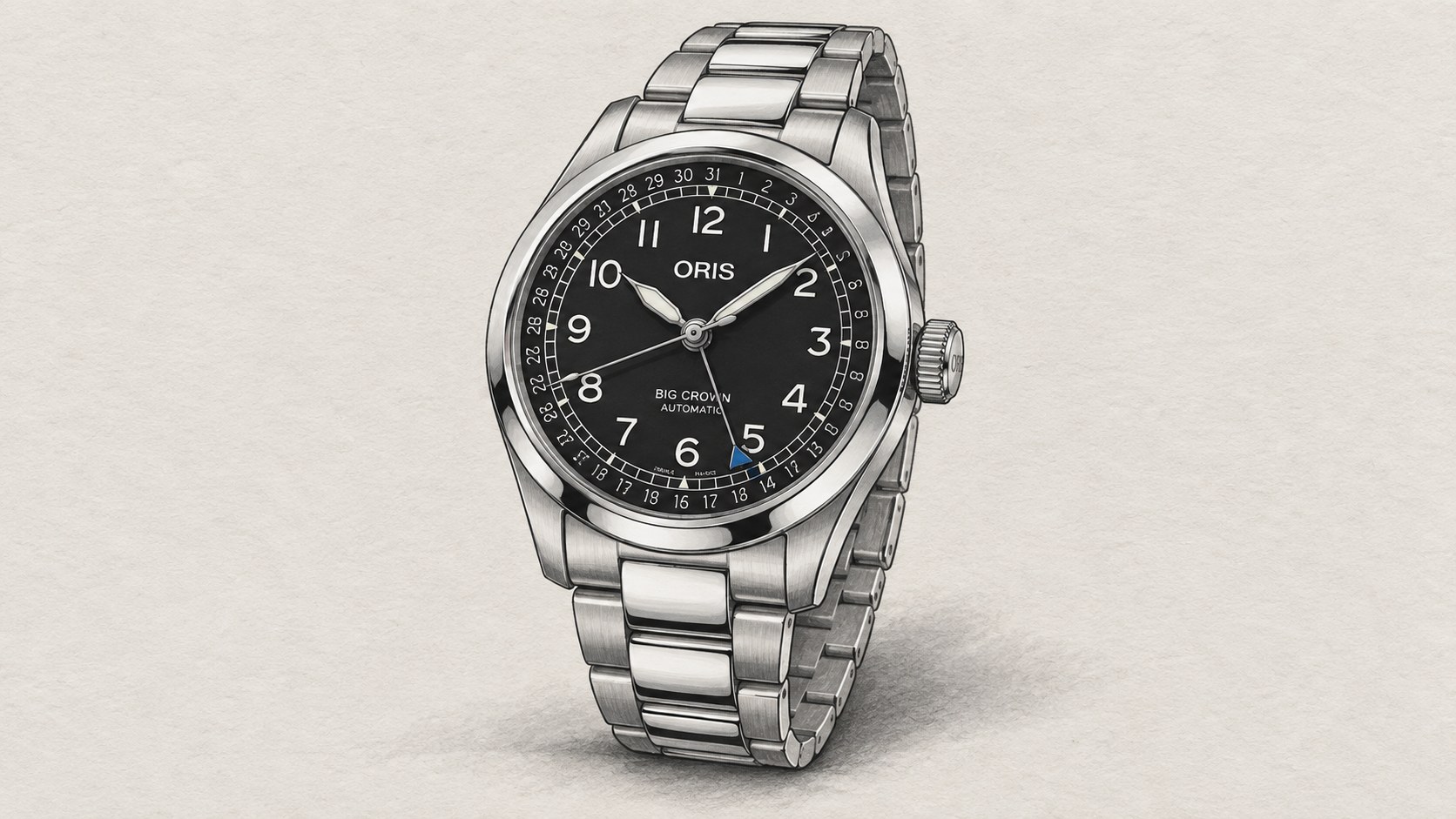
The black-dial reference 01 754 7798 4064-07 8 20 06 is a particularly clear way into the idea. It combines a 40mm steel case with a bracelet and a restrained colour scheme. Oris listed it at £1,750 in the UK when checked, with its current 754-1 automatic movement.
A practical origin, carried into a new case and bracelet
Oris introduced the Big Crown Pointer Date in 1938 for airmen wearing gloves. The large crown and date indication therefore came from a practical brief, even though their shapes now contribute strongly to the watch’s identity. The brand’s account of the latest collection describes a broader range of sizes and colours, together with a new H-link bracelet and Oris-developed clasp. That development makes the current watch a contemporary continuation of the idea, rather than a requirement to dress like a historical pilot. The reference discussed here retains the central pointer date in a black-and-steel combination, with a blue date hand adding a small visual distinction. Its historical relevance lies in that enduring way of presenting useful information.
What the current black-dial reference includes
The exact UK listing specifies calibre 754-1 and 41 hours. Older Big Crown references with calibre 754 can carry different reserve figures; check the complete reference when comparing an offer.
| Specification | 01 754 7798 4064-07 8 20 06 |
|---|---|
| Case diameter and lug width | 40mm; 20mm |
| Case and bracelet | Stainless steel |
| Movement | 754-1 automatic |
| Power reserve | 41 hours |
| Frequency | 28,800 vibrations per hour |
| Functions | Time, central pointer date and stop seconds |
| Front crystal | Double-domed sapphire, inner anti-reflective coating |
| Case back | Screwed steel with mineral-glass display |
| Water resistance | 5 bar |
| Official UK price, 8 September 2026 | £1,750 |
What the pointer gains and what it asks of you
A hand moving around the month provides a different visual reference from a single number appearing in a small aperture. You may enjoy seeing approximately how far through the month you are before reading the exact date. The blue hand also adds movement and colour to a dial that otherwise has a fairly conservative palette.
That does not make the calendar more sophisticated in what it knows. The display still runs through a 31-day cycle, so shorter months require correction. It does not automatically account for February or leap years. Buy it for the way it conveys an ordinary date, not for a perpetual-calendar function it does not offer.
The potential cost is visual activity. The date scale shares space with the time display, and the additional central hand must be distinguishable from the hands you use to read the hour and minute. Check it at arm’s length under ordinary light. If finding the date requires more attention than you want to give it, a well-placed date window may be better for you.
The bracelet changes how the heritage design feels
The current H-link bracelet gives the Big Crown a more continuous steel presence than a leather strap. That may help it fit the role of an everyday watch worn with both office and casual clothes. It also makes accurate sizing important: inspect how the links curve around your wrist and how the clasp sits when your hand rests on a table.
The 40mm diameter is only one part of that fitting. The official page does not give a lug-to-lug measurement or case thickness, so this guide does not invent either. Judge the complete case and the first bracelet links together. If you are ordering remotely, ask for those measurements from the actual seller when fit is uncertain.
The large crown is a recognisable part of the design, but its modern usefulness is personal. You will use it for setting and occasionally restarting the watch. Check whether it is easy for your fingers to grip and whether it meets the back of your hand when your wrist bends.
A simple ownership routine keeps the date useful
Oris’s date-setting instructions cover both window and hand-type calendar displays. They advise against quick-setting the date between 21:00 and 03:00 and recommend approaching the correct day through the time-setting process when establishing morning versus evening. That small routine helps prevent a date which changes at lunchtime rather than midnight.
The 41-hour reserve is practical for a night off the wrist, but a full weekend away may leave it stopped. If you plan to alternate watches frequently, decide whether setting the pointer is an enjoyable interaction or an annoyance. Mechanical convenience depends partly on how regularly you wear the watch.
The Aquis Date 01 733 7792 4154-07 8 19 05P is a useful alternative when you prefer a date window and a stronger water-use brief. It has a 36.5mm steel case, 30-bar rating and current 733-1 movement. It changes the design substantially, which is precisely why it clarifies the choice.
Choose the Big Crown when you enjoy reading the date around the dial and want that feature to give an everyday automatic its identity. The pointer is both functional and aesthetic. Its success depends on whether those two benefits reinforce each other for you each time you look at the watch.
Image: AI-generated editorial illustration of the Oris 01 754 7798 4064-07 8 20 06. Design details are approximate; this is not a product photograph.


