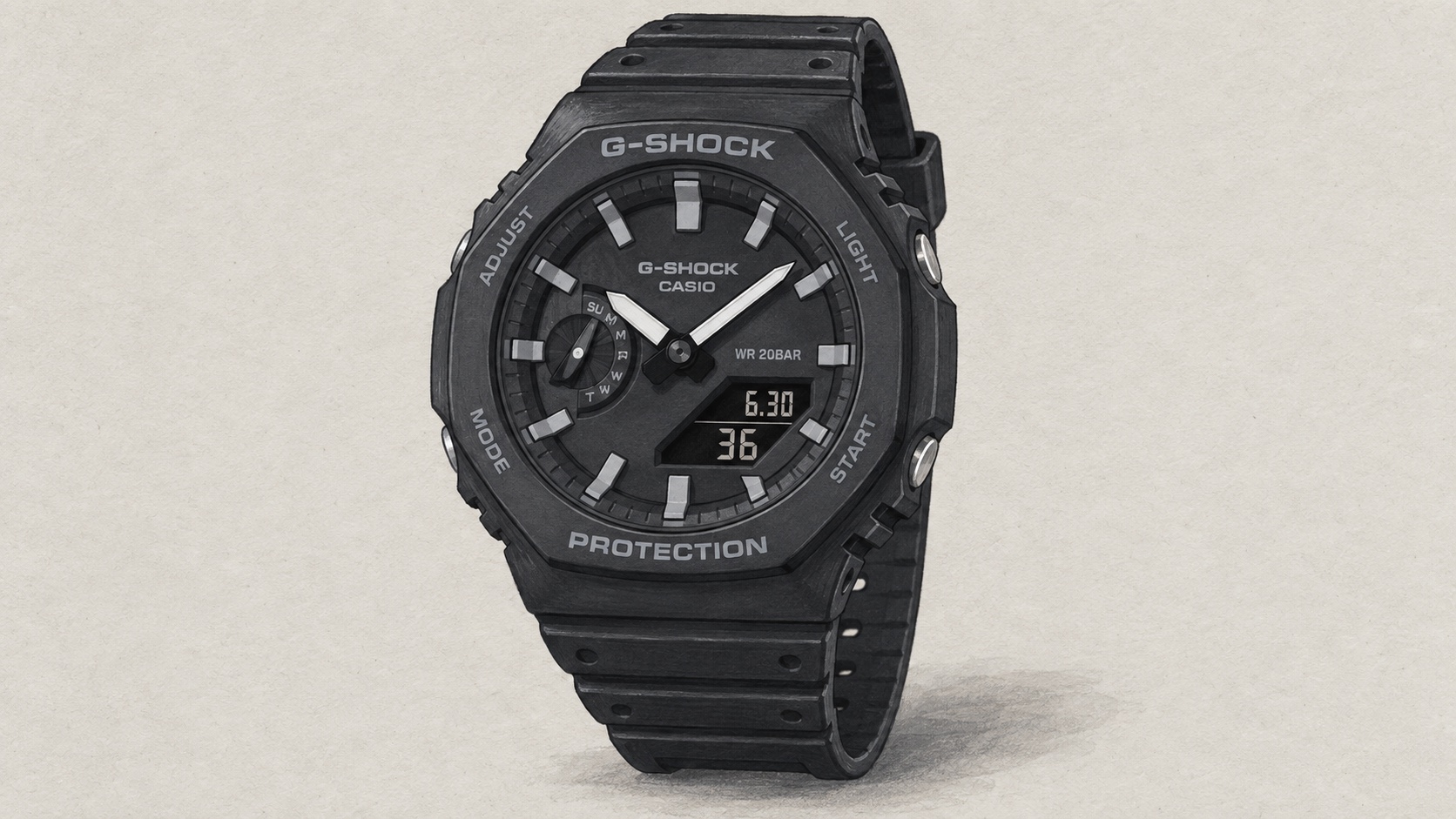
The GA-2100 made G-Shock appealing to buyers who liked the idea of a tough watch but did not want a towering case. Its octagonal bezel and restrained analogue-digital face give it a different appearance from the more elaborate round G-Shocks.
That does not make it a small watch in every direction. The GA-2100-1AER is comparatively slim, but still broad. If you have a smaller wrist, the useful question is which dimension usually bothers you: thickness, width or the way a strap leaves the case. The answer can lead either to this model or to a genuinely smaller member of the 2100 family.
Based on Casio’s published information. Specifications checked on 8 September 2026.
The exact reference
| Case dimensions | 48.5 × 45.4 × 11.8 mm, length × width × thickness |
|---|---|
| Weight | 51 g |
| Construction | Shock resistant; Carbon Core Guard |
| Case and bezel | Carbon / resin |
| Glass | Mineral |
| Water resistance | 200 m |
| Battery | Two SR726W cells; approximately three years |
| Rated accuracy | ±15 seconds per month |
| Display | Analogue-digital |
| Timing functions | World time, stopwatch, countdown timer and alarms |
| Lighting | Separate white LEDs for dial and digital display |
| Connectivity and charging | No Bluetooth; no Tough Solar |
Specification source: Casio UK GA-2100-1AER.
An old design idea expressed with a newer case structure
Casio introduced the GA-2100 in 2019 as a contemporary interpretation of the first G-Shock, the DW-5000C. Rather than reproducing the original digital display, it translated the restrained, angular approach into an analogue-digital watch. Carbon-reinforced resin helped provide the protective structure within a relatively thin case.
In 2022 the GA-B2100 added Bluetooth and Tough Solar to the same broad design direction. That development is useful to a buyer because the names look nearly interchangeable while the ownership routines differ. The original GA-2100 remains battery-powered and independent of a phone connection. Casio’s account of the two generations explains how the later conveniences were added, without making the earlier watch an incomplete version of itself.
Separate the slimness from the footprint
Casio gives the case as 48.5 mm long, 45.4 mm wide and 11.8 mm thick. The last number is a major part of the model’s appeal. The first two make clear why a buyer seeking a truly small watch should still compare alternatives.
A 51 g listed weight also makes this a different proposition from a steel watch of similar width. You may like a broad visual outline provided it does not bring much mass with it. Someone who wants a narrow outline beneath a close cuff has a different problem, and the lower weight does not solve it.
The resin strap is shaped around the case. At a try-on, check whether it follows the wrist near the lugs or stands away before curving down. That one observation is more useful than deciding from a wrist-circumference chart that the watch must fit everyone above a particular number.
The analogue-digital layout has a clear trade-off
The main hands give an ordinary analogue reading of the time. The smaller digital area provides the additional functions without occupying the whole face. A day indicator supplies another piece of information in the dial layout.
This can be an attractive compromise if you want a watch to look primarily analogue while retaining timers and alarms. It is less persuasive if you mainly use the digital information and would prefer it to be larger. A full digital G-Shock dedicates much more of its face to that job.
Take time to try the hand-shift function, which moves the hands away from the digital area. It is a useful accommodation of the hybrid display, but it also reveals the design’s central compromise: the two methods of showing information share limited space.
Choose battery power positively
The GA-2100 uses two SR726W cells, with approximately three years of rated battery life. You do not need to maintain a solar charging habit or install an app to obtain the model’s intended functions. For some buyers, that separation from a phone is part of the attraction.
The trade-off is periodic battery replacement and manual time correction. Casio specifies ±15 seconds per month. World-time settings also require the owner to choose the relevant city and daylight-saving arrangement, rather than assuming the watch knows where it has travelled.
If automatic time correction and light charging are priorities, compare the GA-B2100-1A. Its additional features address those specific tasks. The original model still makes sense for someone who likes a self-contained watch and is content with a conventional battery routine.
There really is a smaller 2100 option
The GMA-P2100-2A measures 46 × 40.2 × 11.2 mm and weighs 40 g. Compared with the GA-2100, it reduces width as well as thickness and length. It is therefore a more direct answer to a smaller-footprint requirement than simply describing the original as slim.
The smaller layout is different, including the absence of the original’s day subdial. Treat that as a design choice, not a reason to assume one model is intended only for a particular gender. The useful comparison is what you can read and how the case sits on your wrist.
Colour and dial contrast also influence the decision. The black GA-2100-1AER is a specific reference within a much wider family. Do not assume every dark variation gives the same visible contrast or uses the same markings.
What makes it useful beyond the shape
Shock-resistant construction, 200 m water resistance, a countdown timer and alarms give the GA-2100 an everyday sports-watch role. The design does not depend solely on the fashionable octagonal outline to justify wearing it.
Those functions can be especially useful when you want to leave a phone out of a short activity. Set an interval, glance at the hands and carry on. If that is how you intend to use it, learn the relevant buttons first rather than judging the watch only by its resemblance to other angular watches.
The verdict
Choose the GA-2100 if you want a relatively thin, light G-Shock with an analogue face and useful digital functions. Its battery-powered independence is a coherent feature when that matches your preferences.
For a smaller wrist, compare the GMA-P2100 rather than relying on the word slim. If charging and automatic correction are the main priorities, compare the GA-B2100 instead. The best 2100 is the one whose proportions and routine solve your actual problem.
Image: AI-generated editorial illustration of the Casio GA-2100-1AER. Design details are approximate; this is not a product photograph.


