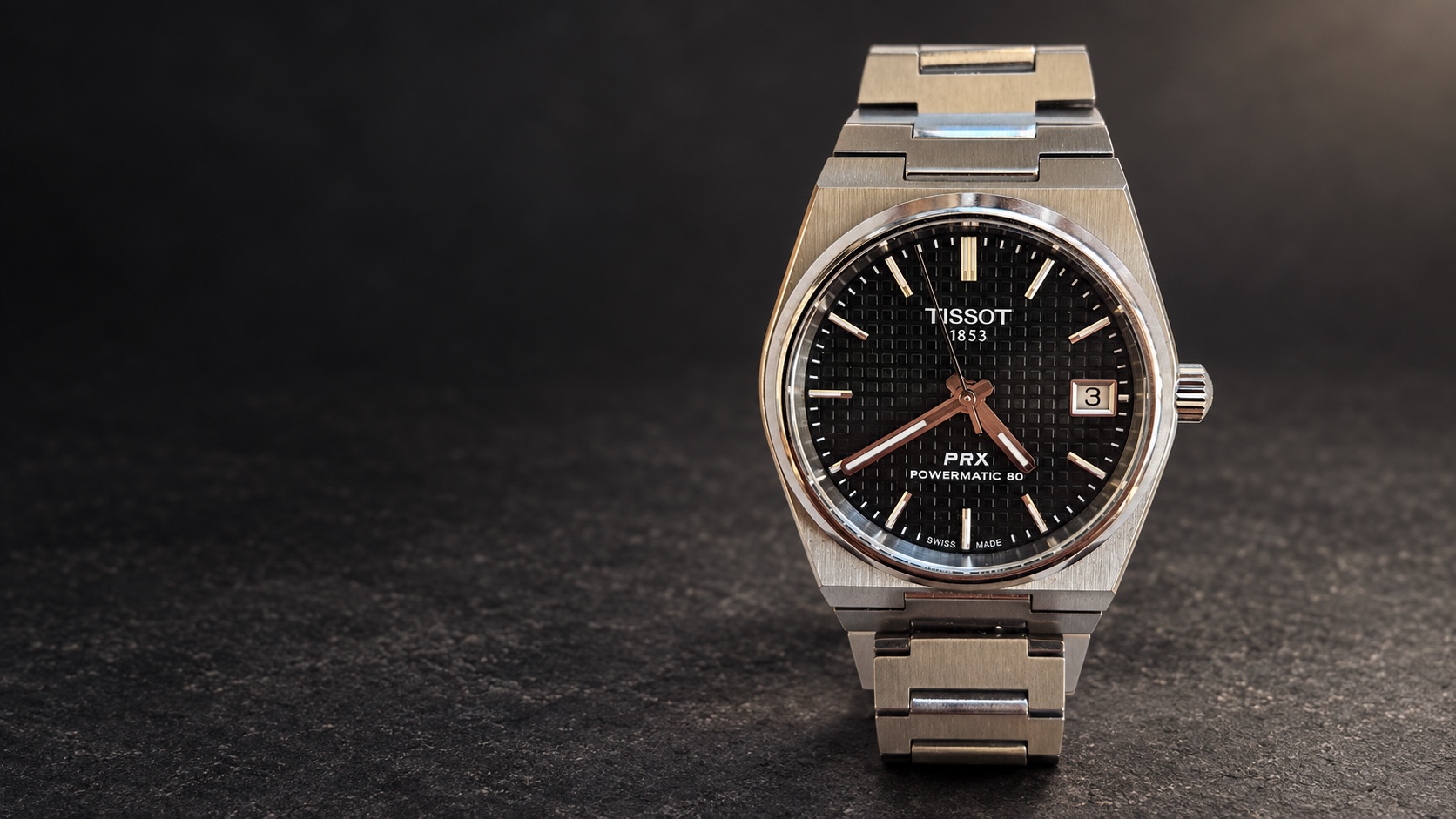
The 38mm Tissot PRX looks like the obvious answer to a familiar dilemma: the 35mm seems small, the 40mm seems large, and something in between ought to settle it. There is another decision hiding inside that extra choice, though. The blue 38mm compared here has a titanium case and bracelet, making it the lightest of the three and the most expensive.
Start with the 35mm if you want a compact steel watch, the 40mm if you prefer a broader design and more weight, or the 38mm if reducing weight is worth paying extra. None gets you a longer stated power reserve. The interesting differences are elsewhere.
Based on Tissot’s published specifications. UK prices checked on 8 September 2026.
Why the smaller PRX belongs in the story
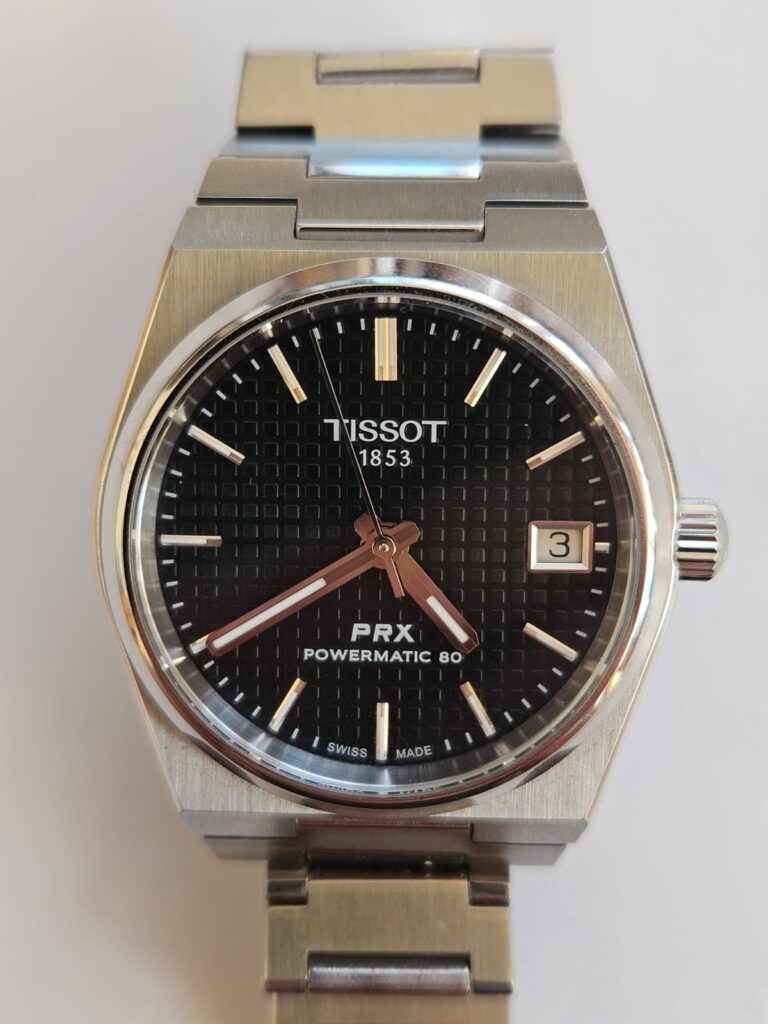
The PRX’s appeal begins with its outline: the angular case flows into a broad, flat bracelet, so the two read as one design. Tissot traces that shape to a watch from 1978 and dates the modern PRX revival to 2021. Its account of the collection’s return puts the late-1970s design at the centre of the story.
The smaller option has a particular connection to that past. When announcing the modern 35mm quartz collection, Tissot described its dimensions as matching the 1978 original. The 35mm automatic considered here is a different reference, but choosing a compact PRX is hardly a retreat from the design’s character.
The 38mm material expansion announced in November 2025 added another approach, including titanium. That history explains today’s choice: compact proportions, a larger steel interpretation, or a lighter middle size.
The three exact references, side by side
This comparison holds dial colour and movement type broadly consistent: three blue-dial automatics on their supplied metal bracelets. The table uses Tissot’s published figures; a sized bracelet will change the watch’s weight. Prices are UK manufacturer prices checked on 8 September 2026 and may change.
| Specification | 35mm steel | 38mm titanium | 40mm steel |
|---|---|---|---|
| Exact reference | T137.207.11.041.00 | T137.807.44.041.00 | T137.407.11.041.00 |
| UK price | £640 | £795 | £640 |
| Diameter | 35mm | 38mm | 40mm |
| Thickness | 10.93mm | 10.98mm | 10.93mm |
| Published weight | 104g | 84g | 138g |
| Case / bracelet | 316L steel / steel | Titanium / titanium | 316L steel / steel |
| Bezel material listed by Tissot | Stainless steel | Stainless steel | Stainless steel |
| Movement | Powermatic 80 automatic | Powermatic 80 automatic | Powermatic 80 automatic |
| Power reserve | Up to 80 hours | Up to 80 hours | Up to 80 hours |
| Water resistance | 10 bar / 100m | 10 bar / 100m | 10 bar / 100m |
| Front crystal | Sapphire, internal antireflective coating | Sapphire, internal antireflective coating | Sapphire, internal antireflective coating |
All three list a date display, Nivachron balance spring, see-through caseback and a quick-release bracelet with a butterfly clasp and push-buttons. Those shared features give little reason to stretch the budget by themselves.
Choose the 35mm for a smaller outline
The 35mm is the place to start if you like the PRX but want less of your wrist occupied by its case and bracelet. That is a preference about proportion, not a rule about who can wear it. A larger wrist can carry a deliberately compact watch; a smaller wrist does not automatically rule out the other versions.
Notice what shrinking the case does not change: its published thickness is exactly the same as the 40mm’s. Buying the 35mm therefore does not buy a thinner watch. If a close-fitting cuff is your main concern, test that separately from how the watch looks from above.
There is no price penalty for choosing it over the larger steel model, either. Both are £640. You can make the decision on the proportions you actually enjoy, without treating the 40mm as better value simply because there is more watch to look at.
Choose the 38mm when lightness matters
The titanium version’s strongest argument is visible in the weight row. At 84g, it is 20g lighter than the smaller steel PRX and 54g lighter than the 40mm. Those differences come from the published figures, not a comparative weighing test.
That gives the £155 premium a concrete purpose. If you have stopped wearing other watches because you dislike their weight, the 38mm deserves an early place in your fitting session. If you enjoy the substantial feel of steel, the extra spend may solve a problem you do not have.
Be precise about the materials, too. Tissot lists a titanium case and bracelet, while its UK specification names stainless steel for the bezel. Calling every exterior component titanium would go beyond that description. Nor does the material name establish scratch resistance or comfort in your own use.
The middle diameter is useful, but it is not a universal answer. You still need to like the way the bracelet meets your wrist. Low weight cannot correct a shape or clasp position that bothers you.
Choose the 40mm for a broader steel PRX
The 40mm makes sense if the broad case and bracelet are precisely what attract you to the design. It gives the outline more presence while retaining the same stated height and price as the 35mm. Whether that feels confident or excessive is a decision to make at normal viewing distance.
Its 138g published weight is the other defining difference. Someone moving from a light digital watch should pay attention to that number. Someone who already enjoys steel bracelets may find it unsurprising. Neither reaction proves anything about quality.
Try the 40mm before assuming a familiar round-watch size will translate directly. The PRX’s bracelet continues the case’s lines, and the first links contribute to the overall impression. Look at your arm in a mirror as well as down at the dial; a close photograph can make the proportions difficult to judge.
What to check at the counter
Ask to compare realistically adjusted bracelets. Several spare links folded beneath a display watch make a poor basis for deciding how it will sit during a working day. With your hand relaxed, check whether the case stays centred; then bend your wrist as you would at a keyboard.
Tissot’s product pages give a measurement labelled “Length”, but do not identify it as the full span across the case and first bracelet links. We have therefore not turned those figures into a supposed lug-to-lug comparison. Ask the retailer to show you the actual footprint of each watch.
The quick-release system also deserves a demonstration if you intend to change straps. Check compatibility against the exact reference. A shared PRX name, or even a similar attachment measurement, is not enough to establish that a strap fits.
The movement is not the deciding vote
All three offer the same stated maximum reserve. Eighty hours gives a fully wound watch room to cover a weekend off, but occasional wear does not establish that it started fully charged. An automatic still needs setting again after it runs down.
Likewise, the shared Nivachron specification is not evidence that one size will keep better time than another. Choose between these references for fit, appearance, material and price. For water use and servicing, follow the instructions for the exact watch rather than reading the depth rating as a promise about every activity.
Which PRX would we put first?
For compact proportions and the lower price, start with the 35mm. For less weight and an intermediate case size, start with the 38mm titanium. For a broad steel watch, start with the 40mm.
If all three appeal, compare the two steel models first. That establishes whether your real question is size. Then try the titanium: the decision is whether its different size and lower weight are worth another £155 to you. The best PRX is the one whose compromises suit your routine.
The linked Tissot product pages are direct, non-affiliate sources and provide current purchase information.
Hero image credit: AI-composed background, lighting and reframing by The Wrist Guide, based on Tissot PRX 35mm.jpg by Soulreaper (CC BY-SA 4.0). The image adaptation is also licensed CC BY-SA 4.0. Generated fine details may differ.